Centralized and Fragile: Rethinking the Feature Store Before It Becomes Your ML Platform's Weakest Link
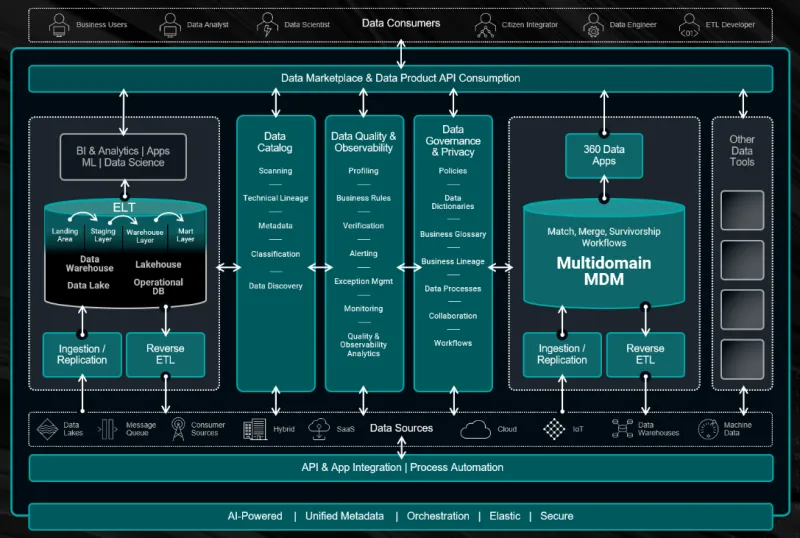
Photo: centralized data platform server architecture machine learning infrastructure, via www.informatica.com
The feature store has achieved something rare in enterprise software: near-universal endorsement. Analysts recommend it, platform vendors sell it, and engineering leaders describe it as a foundational component of mature ML infrastructure. The appeal is genuine—a single, governed repository of features that ensures training and serving consistency, enables reuse across teams, and eliminates the duplicated feature computation that plagues organizations where ML development is distributed across multiple teams.
The reality is more complicated. Feature stores introduce a category of failure modes that are qualitatively different from those of the systems they replace, and those failure modes are systematically underweighted in the architectural discussions that precede adoption. This article does not argue that feature stores are always wrong. It argues that the decision to adopt one deserves the same skeptical engineering analysis applied to any system that becomes a critical dependency for production inference.
The Single Point of Failure That Ships with the Architecture
The defining characteristic of a feature store is centralization. Features are computed, stored, and served from a shared platform that all consuming systems depend upon. This centralization is the source of the feature store's primary value proposition—consistency, reuse, governance—and simultaneously its most significant structural risk.
When a centralized feature store serves production inference, it becomes a synchronous dependency in the critical path of every model that reads from it. A latency spike in the feature store is a latency spike in every serving endpoint that depends on it. A partial outage in the feature store is a partial outage in every model that cannot fall back to locally computed features. In a distributed architecture where model serving, feature computation, and data storage are decoupled, failures tend to be isolated. In a centralized feature store architecture, failures tend to be correlated.
This is not a hypothetical concern. Engineering teams operating large-scale feature stores consistently report that their most severe production incidents involve cascading failures that originate in the feature store and propagate to all downstream consumers simultaneously. The blast radius of a feature store failure is, by design, maximized—because the entire point of the system is that everything depends on it.
Latency: The Cost That Compound Fees Hide
Feature store vendors and internal platform teams alike tend to report feature retrieval latency in terms of median values—typically in the single-digit millisecond range for well-operated systems. This framing obscures the distribution that actually matters for production inference: the tail.
P99 and P99.9 latencies for feature store retrievals under production load are substantially higher than median values, and they are highly sensitive to the operational conditions that production systems routinely encounter: cache eviction under memory pressure, garbage collection pauses in JVM-based storage systems, network congestion during peak traffic periods, and lock contention during concurrent writes from feature computation pipelines.
For models where inference latency is a user-facing quality metric—real-time recommendation, fraud detection, content ranking—the tail latency of feature retrieval can account for a disproportionate share of total serving latency. Teams that benchmark feature store performance in isolation, without measuring its contribution to end-to-end serving latency under realistic load, frequently discover this only after deployment.
The latency problem is compounded when a model requires features from multiple feature groups—a common pattern in production systems where user features, item features, and contextual features are managed separately. Each additional feature group retrieval adds latency and adds a potential failure point. Batching retrievals mitigates this partially, but batching introduces its own complexity and is not always compatible with the serving architectures that teams have already built.
Consistency: The Promise That Requires Constant Engineering
Training-serving consistency—ensuring that the feature values used during model training match those available at serving time—is the most commonly cited motivation for feature store adoption. The argument is sound: inconsistency between training and serving features is a significant and underappreciated source of production model degradation. A feature store that maintains a consistent feature registry and enforces point-in-time correctness during training data generation does address this problem.
What is less frequently discussed is the ongoing engineering effort required to maintain that consistency as the platform evolves. Feature definitions change. Upstream data sources change. Feature computation logic is updated to fix bugs or incorporate new signals. Each of these changes creates a window during which the feature store may serve values that are inconsistent with the model's training distribution, unless the platform has been engineered with explicit versioning, backward compatibility guarantees, and coordinated rollout procedures for feature updates.
Building and operating those mechanisms is non-trivial. Organizations that adopt commercial feature store platforms often discover that the consistency guarantees they were sold require substantial custom engineering to implement correctly for their specific data infrastructure. Organizations that build feature stores internally face the same challenge with fewer vendor resources to draw on.
The Distributed Alternative: When Local Computation Wins
For many ML systems, the alternative to a centralized feature store—computing features locally within each serving endpoint at inference time—is operationally simpler and architecturally more resilient, despite its apparent inefficiency.
Local feature computation eliminates the external dependency that makes centralized feature stores a single point of failure. It reduces serving latency by removing a network round-trip. It simplifies the consistency problem by co-locating feature computation logic with the model that consumes it. And it allows individual teams to evolve their feature engineering independently without coordinating through a shared platform.
The objections to local computation are real but often overstated. Duplicated computation is a genuine cost, but in most organizations, feature computation is not the dominant infrastructure expense—model serving is. Lack of governance is a legitimate concern, but governance can be enforced through code review, shared libraries, and automated testing without requiring a centralized runtime system. Inability to reuse features across teams is a valid limitation, but reuse at the code level—shared feature engineering libraries—provides most of the benefit at a fraction of the operational complexity.
Build, Buy, or Bypass: A Framework for the Decision
The decision about whether to adopt a feature store should be grounded in three questions. First, what is the actual scale of feature reuse in the organization? If multiple teams are independently computing the same features from the same upstream data, the efficiency argument for centralization is strong. If teams operate largely independent feature sets, the reuse benefit is limited.
Second, what are the serving latency requirements for the models that would consume the feature store? Systems with tight latency budgets should treat feature store retrieval latency—including tail latency—as a first-order constraint, not an afterthought. Third, does the organization have the operational capacity to maintain a centralized feature platform at production quality? Feature stores require dedicated engineering investment to operate reliably. Teams that understaff this function consistently produce feature stores that are less reliable than the distributed alternatives they replaced.
The feature store is a powerful tool for organizations whose scale and team structure genuinely benefit from centralized feature management. For organizations that adopt it because it appears in every ML platform reference architecture, it is frequently a source of operational complexity and reliability risk that outweighs its benefits. Choosing deliberately, with clear-eyed accounting of both the benefits and the failure modes, is the engineering standard that the decision deserves.