Designing for Failure: Why Most Production AI Systems Lack the Resilience They Actually Need
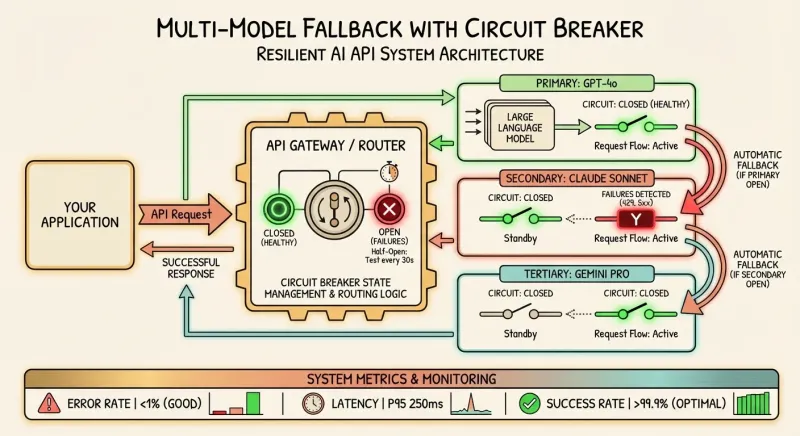
Photo: AI system resilience fallback architecture server reliability engineering, via ofox.ai
There is a persistent gap between how AI systems are designed and how they are expected to behave when things go wrong. Most teams invest considerable effort in optimizing model performance under normal operating conditions—tuning accuracy, reducing latency, controlling costs—and comparatively little in defining what the system should do when the primary model is unavailable, producing anomalous outputs, or operating outside the distributional range on which it was trained.
This asymmetry is not the result of negligence. It reflects a reasonable prioritization during development, when the primary concern is making the system work at all. But it creates a structural vulnerability that becomes visible only in production, often at the worst possible moment: during a high-traffic event, a data pipeline outage, or a model degradation that goes undetected until users are already affected.
The question this article addresses is not whether AI systems fail—they do, reliably and in ways that are difficult to predict in advance—but whether those failures are handled by design or by accident.
The Anatomy of an AI System Failure
AI system failures in production fall into three distinct categories that require different mitigation strategies.
Hard failures are the most visible: a model serving endpoint returns a 503, a dependency service is unreachable, a GPU node crashes mid-inference. These failures are detectable immediately through standard monitoring and typically have obvious remediation paths—retry logic, failover to a secondary serving instance, circuit breakers.
Soft failures are considerably more dangerous because they are invisible to standard infrastructure monitoring. The serving endpoint is healthy. Predictions are being returned on time. But the model is producing outputs that are systematically wrong—because the input distribution has shifted, because a feature pipeline is silently returning stale data, because a recent model update introduced a regression that accuracy metrics have not yet surfaced. Soft failures can persist for hours or days before they are detected, and the damage they cause scales with the duration.
Capacity failures occur when a system is technically operational but cannot sustain the load being placed on it. Latency climbs, batch queues grow, timeout rates increase, and the system begins shedding requests. In AI systems, capacity failures are often nonlinear: as load increases, caching effectiveness drops, cold-path inference increases, and the system degrades faster than linear scaling would predict.
Why Fallback Strategies Are Absent
The absence of robust fallback strategies in most production AI systems traces to a combination of organizational and technical factors.
Organizationally, fallback design is often treated as an operational concern rather than an engineering one, and it is frequently deferred until after initial deployment. By that point, the primary system has become load-bearing, the team has moved on to other priorities, and the complexity of retrofitting graceful degradation into an existing architecture makes the work easy to deprioritize indefinitely.
Technically, building a credible fallback requires answering a question that many teams have not explicitly considered: what is the minimum acceptable behavior of this system when the primary model is unavailable? For some systems, the answer is a simpler heuristic. For others, it is an older model version. For others still, it is a deterministic rule-based system that produces lower-quality but reliable outputs. Defining that minimum acceptable behavior forces a clarity about system requirements that the development process rarely demands.
Engineering Graceful Degradation: Four Practical Patterns
Tiered model fallback chains — define an explicit hierarchy of models, ordered by capability and resource requirement. The primary model is the highest-capability, highest-cost option. The secondary model is smaller, faster, and cheaper—perhaps a distilled version of the primary, or a previous model checkpoint known to be stable. The tertiary layer is a lightweight model or a purely heuristic system that requires no GPU and can run indefinitely without operational intervention. Each tier has defined activation conditions: the secondary activates when the primary exceeds a latency threshold or returns an error rate above a configured ceiling; the tertiary activates when the secondary is also unavailable. This chain should be tested regularly, not just designed.
Output anomaly detection as a soft-failure trigger — deploy a lightweight monitor that evaluates the statistical properties of model outputs in real time: prediction score distributions, output token entropy in generative systems, confidence calibration against held-out ground truth. When output statistics deviate significantly from baseline, the monitor triggers a fallback transition before users experience degraded quality. This is the mitigation for soft failures, which standard infrastructure monitoring cannot detect.
Heuristic shadow systems — for every AI-driven decision in a production system, maintain a deterministic, rule-based analog that can produce a reasonable output without any model inference. This shadow system should be kept current with business logic and tested regularly. It is not intended to match the quality of the AI system; it is intended to be correct enough that the product remains functional when the AI system is unavailable. In many domains—fraud scoring, content filtering, basic recommendation—well-maintained heuristics deliver 70–80% of the value of the full model at near-zero compute cost.
Graceful load shedding with explicit degradation signaling — when a capacity failure is detected, the system should shed load deliberately rather than allowing latency to climb until timeouts cascade. Shedding load means routing a fraction of requests to cheaper, faster fallback models and explicitly communicating to downstream systems and users that degraded mode is active. This transparency is operationally valuable: it allows support teams to set expectations, prevents users from misinterpreting slow responses as errors, and creates a clear audit trail for post-incident review.
The Organizational Requirement
Graceful degradation cannot be engineered by a single team in isolation. It requires agreement across engineering, product, and operations on what constitutes acceptable degraded behavior—a conversation that is often uncomfortable because it requires product teams to explicitly acknowledge that the AI system might not always be available at full capability.
That conversation is worth having. The alternative is a system whose failure modes are defined by accident rather than design, where the first time anyone learns what the system does when the primary model fails is during a production incident.
Resilience in AI systems is not primarily a technical problem. It is a design problem that has technical solutions. The teams that build AI infrastructure capable of sustaining user trust under adverse conditions are the ones that treat failure as a first-class design requirement, not an afterthought. Building that discipline into the development process—before deployment, not after the first incident—is what separates systems that users can depend on from systems that merely work when everything goes right.