Eliminating Redundant Computation in Multi-Model Pipelines: A Practical Guide to AI-Layer Cache Coherence
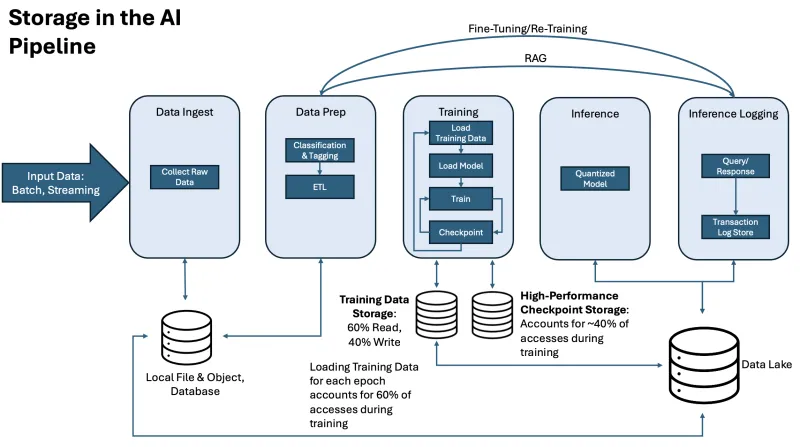
Photo: multi-model AI pipeline server computation data center infrastructure, via nand-research.com
As AI systems mature, they rarely consist of a single model operating in isolation. A modern production recommendation pipeline might invoke an embedding model for user context, a retrieval model for candidate generation, a ranking model for final ordering, and a safety classifier before serving results—all within a single request lifecycle. Each of these models was likely developed and evaluated independently. Almost none of them were designed to share computation with the others.
The result is a common and expensive architectural pattern: multiple models independently computing overlapping representations of the same underlying data, with no mechanism for reusing work already done. In high-throughput systems, this redundant computation is not a minor inefficiency. It is a structural cost that scales directly with request volume and compounds as the number of models in the pipeline grows.
Characterizing the Redundancy Problem
To understand where redundant computation originates, it is useful to think about the layers at which AI models process information.
At the lowest layer, raw inputs—text tokens, user identifiers, item identifiers, image pixels—must be converted into dense vector representations before any model can operate on them. In a multi-model system, if three models each independently embed the same user identifier, the embedding computation occurs three times. If the embedding model is non-trivial in size, this triplication is immediately costly.
At intermediate layers, models build progressively more abstract representations of their inputs. In transformer architectures, the attention computation over an input sequence is expensive and produces rich contextual representations that are discarded after the model generates its output. If a second model processes the same input sequence through a similar attention stack, it is reconstructing representations that the first model already computed and threw away.
At the feature level, many models in the same domain share conceptual features—session length, content category affinity, recency signals—that are computed independently by each model's preprocessing pipeline, even when they draw from identical upstream data sources.
Instrumenting for Redundancy Detection
Before addressing redundancy, teams must measure it. Instrumentation should focus on three signals.
Input overlap rate — for each model in the pipeline, log a hash of the input tensor at the point it enters the model. Compare hashes across models within the same request. An overlap rate above 40% between any two models is a strong signal that shared upstream computation is feasible.
Embedding reuse potential — identify all calls to embedding services or embedding layers across the pipeline and determine what fraction involve identical inputs within a configurable time window. In systems with any degree of repeated traffic—returning users, popular items, common query patterns—this fraction is typically substantial.
Intermediate tensor similarity — for models that share architectural families (e.g., two transformer-based models processing the same text), measure the cosine similarity between intermediate layer outputs. High similarity at early layers indicates that both models are learning similar low-level representations and may be candidates for a shared encoder trunk.
Architectural Patterns for Eliminating Duplication
With redundancy characterized, several architectural interventions address it at different layers of the stack.
Shared embedding layers with frozen or slowly-updated weights — when multiple models embed the same entity types, a single embedding table can serve all of them. This requires careful consideration of update frequency: if one model's training would benefit from embedding updates that would harm another's performance, a frozen shared embedding with model-specific projection layers is often the right compromise. The projection layers are cheap; the embedding computation is not.
Request-scoped intermediate result caching — within a single request lifecycle, intermediate tensors computed by an upstream model can be stored in a lightweight in-memory cache keyed by input hash and made available to downstream models. This pattern is most effective in sequential pipelines where a retrieval model feeds a ranking model, but it applies to any topology where models share input subsets. The cache scope should be the request, not a persistent store, to avoid staleness and memory pressure.
Cross-request embedding caches with TTL-based invalidation — for entity types with high request repetition—popular product identifiers, frequently queried users, common search terms—a short-lived distributed cache for embedding vectors can eliminate the majority of embedding computation system-wide. The cache hit rate for the top 10% of entities in most production systems is high enough to justify the infrastructure investment. TTL values should be calibrated against the rate at which the underlying embedding model is retrained.
Shared encoder trunks with task-specific heads — when multiple models process the same input modality and exhibit high intermediate representation similarity, a multi-task architecture with a shared encoder and separate task-specific heads can replace independent models entirely. This is a larger architectural investment than caching, but it eliminates redundancy at the source rather than working around it, and it frequently improves individual task performance through shared representation learning.
Orchestration Patterns That Enable Coherence
None of the above strategies are effective without an orchestration layer that is aware of computation across models, not just within them. Most serving frameworks treat each model as an independent black box, which makes cross-model optimization invisible to the infrastructure.
An AI-layer orchestrator should maintain a computation graph for each request that tracks which inputs have been processed by which operations and what intermediate results are available for reuse. This is architecturally similar to query plan optimization in database systems: the orchestrator inspects the full computation required to satisfy a request and eliminates redundant operations before dispatching work to individual models.
Building this capability from scratch is significant engineering work. Teams that cannot justify that investment should at minimum implement a shared embedding service as a first-order approximation: a dedicated, high-performance service that all models call for embedding lookups, with its own caching layer, rather than each model embedding independently. This single change frequently reduces system-wide embedding compute by 50–70% in multi-model pipelines.
Measuring the Impact
The business case for AI-layer cache coherence is straightforward but requires measurement to make concrete. Teams should instrument total compute cost per request before and after each intervention, tracking GPU utilization, wall-clock latency per model, and cost per thousand requests. In systems with significant input overlap, the combined effect of shared embeddings and request-scoped intermediate caching typically reduces per-request compute by 25–45%, with corresponding reductions in infrastructure cost and latency.
The goal is not to reduce model independence or compromise the ability to update, retrain, or replace individual models. It is to ensure that the computation shared between models is performed once, not repeatedly, and that the infrastructure reflects the actual information flow of the system rather than the organizational boundaries under which its components were built.