When the Pipeline Isn't Yours: Managing Cascading Failures Across Third-Party AI Dependencies
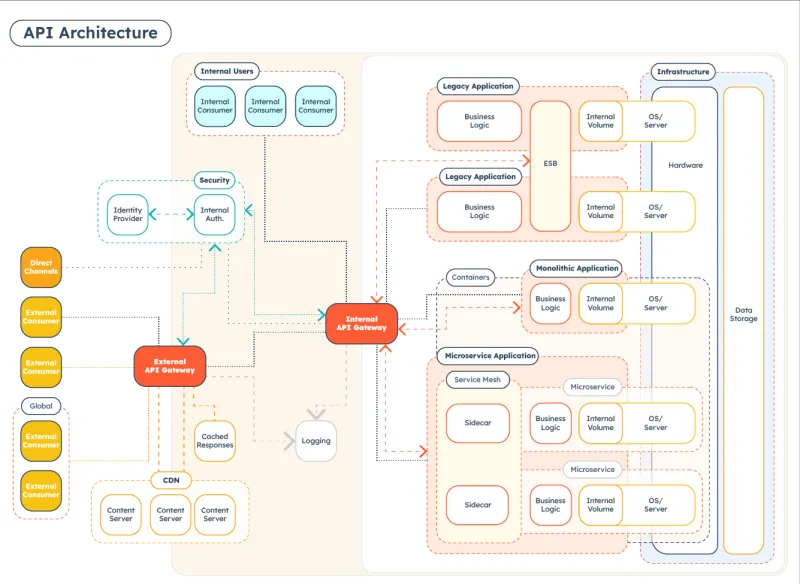
Photo: interconnected network nodes API integration system architecture diagram, via www.hubspot.com
The modern AI pipeline is, in many organizations, less a coherent engineering artifact than a negotiated coalition of external services. Vector databases hosted by specialized vendors. Embedding models served through managed APIs. Large language model inference routed through third-party endpoints. Proprietary reranking services bolted onto retrieval pipelines. Each of these components may be individually well-engineered and contractually reliable. Together, they constitute a distributed system whose failure modes are neither well-understood nor adequately planned for by the teams that depend on them.
This is not primarily a technology problem. It is an architectural philosophy problem—one that has its roots in the reasonable desire to ship faster by consuming rather than building, and one that extracts its costs slowly and then all at once.
The Illusion of Reliability at the Component Level
Vendors of managed AI services typically publish uptime SLAs that appear robust in isolation. 99.9% availability sounds reassuring until you recognize that a pipeline with five such dependencies, each independently at 99.9%, has a combined availability ceiling of approximately 99.5%—and that figure assumes failures are independent, which they frequently are not.
Dependency failures in AI pipelines tend to cluster. A content moderation service and an embedding API sourced from the same cloud provider will often degrade simultaneously during a regional incident. An LLM provider experiencing capacity constraints may throttle requests in ways that cascade through every downstream system depending on its outputs. The statistical independence assumption that underlies naive availability calculations does not hold in practice, and the gap between assumed and actual pipeline reliability can be substantial.
Beyond raw availability, managed AI services introduce a category of failure that has no direct analog in traditional software dependencies: silent behavioral change. A vendor updating an embedding model without versioning guarantees can invalidate an entire vector index overnight. An LLM provider adjusting its output formatting, safety filtering, or context handling can break downstream parsing logic in ways that do not surface as errors—they surface as degraded outputs that pass all automated checks and only reveal themselves through user behavior or manual review.
The Lock-In Tax
Vendor lock-in in AI systems is qualitatively different from lock-in in conventional software. Switching a database vendor is a significant engineering undertaking, but the migration path is well-understood and the behavior of the replacement system is deterministic. Switching an embedding model provider requires re-embedding every document in your corpus, rebuilding your vector index, and re-validating retrieval performance—because different embedding models produce geometrically incompatible representations of the same content.
This switching cost is not incidental. It is structural. And it means that the initial decision to adopt a particular managed embedding service carries a long-term commitment that is rarely fully costed at the time it is made. Teams that adopt managed AI services because they are convenient at the prototype stage frequently discover that the operational dependency they have created is far more durable than the prototype itself.
The business consequences of this lock-in become most visible during vendor pricing changes, service degradation events, or deprecation announcements. At each of these moments, the engineering cost of migration is weighed against the ongoing cost of the dependency, and teams that did not architect for replaceability find that migration is effectively prohibitive—not because it is technically impossible, but because the accumulated coupling makes it too expensive to justify.
Failure Modes That ML Engineering Practices Miss
Conventional ML engineering is well-equipped to handle model-level failures: accuracy degradation, distribution shift, training instability. It is substantially less equipped to handle the failure modes introduced by external service dependencies.
Rate limiting as a silent degradation vector. When a third-party API begins throttling requests under load, the typical response is increased latency or partial request failures. In a pipeline without explicit handling for this condition, the result may be incomplete outputs that proceed through the system as if they were complete, introducing subtle errors that are difficult to trace to their source.
Schema drift in API responses. Vendors add fields, deprecate parameters, and restructure response formats. Pipelines that parse API responses with brittle assumptions about structure will fail in ways that are often silent—returning null values or default behaviors rather than explicit errors—until the accumulated effect becomes visible in downstream metrics.
Asynchronous contract violations. Some managed services, particularly LLM APIs, make implicit behavioral commitments that are not captured in their formal API contracts. Output length distributions, response latency profiles, and refusal rate patterns are all subject to change without notice. Systems designed around these implicit properties will experience degradation that is difficult to attribute and harder to remediate.
Designing for Graceful Degradation
The engineering response to external dependency risk is not to eliminate external dependencies—the productivity benefits of managed AI services are real and the alternative of building equivalent infrastructure in-house is not economically viable for most organizations. The appropriate response is to architect systems that can tolerate dependency failures without catastrophic outcomes.
This requires several deliberate design choices.
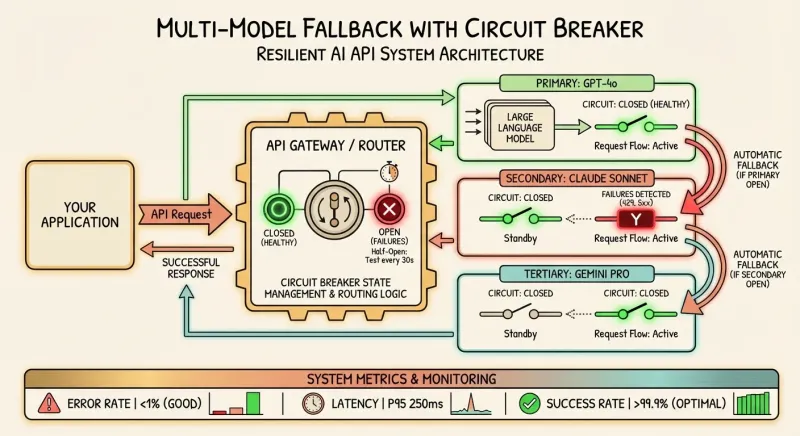
Explicit fallback hierarchies. Every external dependency should have a documented fallback behavior that activates when the primary service is unavailable or degraded. For embedding services, this may mean maintaining a local, lower-quality embedding model capable of serving requests at reduced fidelity. For LLM APIs, it may mean routing to an alternative provider or returning cached responses for common query patterns. The key requirement is that fallback behavior is pre-specified and tested, not improvised during an incident.
Behavioral contract testing. In addition to conventional API contract tests that validate response schemas, AI pipelines should include behavioral contract tests that characterize the statistical properties of external service outputs—output length distributions, confidence score ranges, response latency percentiles. Deviations from these behavioral baselines should trigger alerts before they propagate through the pipeline.
Dependency abstraction layers. Direct coupling between business logic and specific vendor APIs is an architectural liability. Introducing abstraction layers that encapsulate vendor-specific behavior behind stable internal interfaces reduces the migration cost when vendor relationships change and makes it possible to swap implementations in testing environments without modifying application code.
Isolation of dependency failure blast radius. Pipeline components that depend on external services should be isolated such that their failure does not propagate to components that do not share that dependency. Circuit breaker patterns, bulkhead isolation, and asynchronous processing queues all serve to contain the impact of external service failures to the portions of the system that are genuinely affected.
The Architectural Posture That Scales
The organizations that manage external AI dependencies most effectively share a common architectural posture: they treat every third-party service as a temporary convenience rather than a permanent foundation. This posture does not require building everything in-house. It requires designing every integration with the assumption that it will eventually need to be replaced, and investing in the abstraction and fallback infrastructure that makes replacement tractable.
The alternative—building production AI systems around the assumption that external services will remain available, affordable, and behaviorally stable indefinitely—is an optimism that the operational record of the industry does not support. The dependencies you accept today are the failure modes you will be debugging at the worst possible moment. Designing for that reality is not pessimism. It is engineering.